Khan-Tengri Peak Expedition 2013. Khan Tengry Peak Climbing

|
Attention!
Special offer for Khan-Tengri Peak
expedition 2013!
Guaranteed departure date for an
expedition with an experienced mountaineering guide:
27 July to 20 August
Basic program Bishkek-Bishkek:
|
27.07.12 |
Arrival to Bishkek.
Transfer and accommodation in the hotel. |
|
28.07.12 |
Transfer Bishkek –
Karkara BC. Accommodation
in double tents. Overnight. |
|
29.07.12 |
Helicopter flight Karkara BC
– South Inylchek BC (4000 m asl) |
|
30.07.12-17.08.12 |
Acclimatization and ascending
program |
|
18.08.12 |
Helicopter flight South
Inylchek BC – Karkara BC.
Transfer to Bishkek. Accommodation in the hotel. |
|
19.08.12 |
Free day in Bishkek.
|
|
20.08.12 |
Transfer to the airport.
Departure from Bishkek. |
Cost of special
program in 2013: 1850 Euro/person.
Cost
includes services of full package with additional services:
·
Professional mountaineering guide:
- group of 1-3 pax
– 1 guide
- group of 4-6 pax
- 1 guide and 1 guide’s assistant
- group of 7-10 pax
- 1 guide and 2 guide’s assistants
·
Installed high-altitude tents
(3 pax in 1 tent!)
·
Group mountaineering equipment: ropes (if
needed), gas cartridges and gas stoves, cooking set
·
High-altitude food
Full
package includes:
- meeting/seeing-off at the airport
in Bishkek or at railway station in Bishkek;
- transfer airport in Bishkek– hotel
- airport in Bishkek;
- transfer Bishkek to helicopter
landing spot in Karkara and back;
- helicopter flight to BC and back;
- unlimited luggage weight on the
helicopter flight to BC and back;
- accommodation in the hotel in
Bishkek with breakfast and in Karkara base camp with full board (no more
then 4 nights only in total!);
- accommodation in double tents with
full board at BC “South Inylchek“;
- free usage of hot shower and sauna,
toilet and cloak-room at BC “South Inylchek“;
- consultancy service of local guide;
- consultancy of doctor;
- registration with local Rescue
Party;
- ecology fee payable for usage of
territory at BC;
- usage of long-distance radio
telecommunication service;
- rent of ultra-short wave radios
during ascents;
- usage of fixed ropes on the route;
- change of air-flight and railway
tickets;
- frontier zone permit;
- official registration with
authorities of Kyrgyzstan and visa support letter (if needed);
Please note, porter services are not
included into the cost of a program and paid additionally.
Porter services:
BC – Camp 1 – 5 Euro/per kg
Camp 1 – Camp 2 – 10 Euro/per kg
Camp 2 – Camp 3 – 10 Euro/per kg
Note:
Cost of porter services is
calculated for both ascending and descending.
|
Key Information
Tour Duration: 21
day(s)
Group Size: 1
- 10
people
Destination:
Kyrgyzstan
Coordinates: 42°12′39″N 80°10′30″E
Specialty Categories: Mountain Climbing/Ascending Mountain Peaks
Season: July - August
International Airfare Included: No
Helicopter Flight to BC and back: Yes
Personal Travel Insurance Included: No
Personal Equipment Included: No
Tour Customizable: Yes
Price Per Person: Full package for 2013 is 1400 Euro Self Guided
Mountain Guides Availability: Yes
Mountain Guide Service: 1 person – 1200 Euro; 2 person – 750 Euro per person; 3 person –
600 Euro per person.
The Recommended Guide:Climber Ratio: 1:3.
Supplier: tel. +998 98 3039846; E-mail: pagetour@ya.ru
Note:
- Climbing to 7000m requires excellent physical fitness and good health. You must be able to walk at altitude for several days consecutively. Average walking time is around 6-7 hours per day. Daily altitude gain is about 500-800 m. You need to be able to handle adverse weather and be comfortable camping on snow covered ground.
- Your
insurance should permit you to work on a height above 4200 m.
Khan-Tengri Peak Expedition (7,010 m)
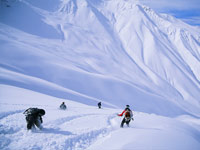
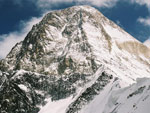
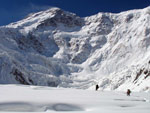
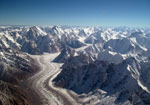
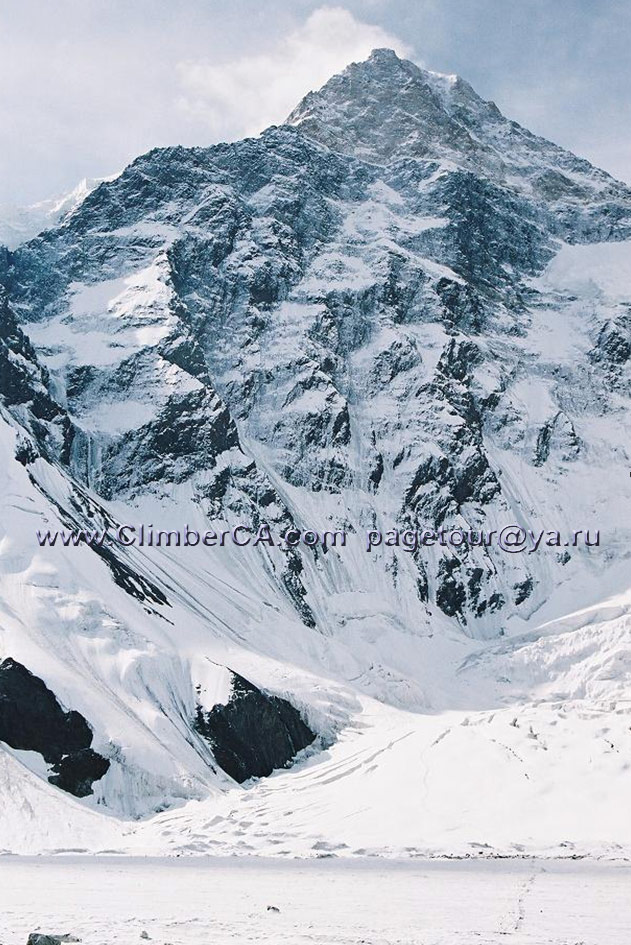
 Khan Tengri is a massive marble pyramid, covered in snow and ice. At sunset the marble glows red, giving it the Kazakh name "Kan Tau" (blood mountain). Located just across the South Ingelchek (or Inylchek) glacier, 16 km north of
the Pobeda Peak (Jengish Chokusu), Khan Tengri was originally thought to be the highest peak in the Tien Shan because of its dramatic, steep shape, compared to the massive bulk of
Pobeda Peak. This perception was probably also due to Khan Tengri's visibility across the plains of southern Kazakhstan while Jengish Chokusu remains out of view of civilization. Khan Tengri is a massive marble pyramid, covered in snow and ice. At sunset the marble glows red, giving it the Kazakh name "Kan Tau" (blood mountain). Located just across the South Ingelchek (or Inylchek) glacier, 16 km north of
the Pobeda Peak (Jengish Chokusu), Khan Tengri was originally thought to be the highest peak in the Tien Shan because of its dramatic, steep shape, compared to the massive bulk of
Pobeda Peak. This perception was probably also due to Khan Tengri's visibility across the plains of southern Kazakhstan while Jengish Chokusu remains out of view of civilization.
Khan Tengri (Uighur, translated as "Lord of the spirits", or "Lord of the sky"; or Turkic translated as "Ruler of Skies", "Ruler Tengri") is a mountain of the Tian Shan mountain range. It is located on the Kyrgyzstan—Kazakhstan border, east of lake Issyk Kul. Its geologic elevation is 6,995 m (22,949 ft), but its glacial cap rises to 7,010 m (22,999 ft). For this reason, in mountaineering circles, including for the Soviet Snow Leopard award criteria, it is considered a 7000-metre peak. It is also known as Khan Tangiri Shyngy, Kan-Too Chokusu, Pik Khan-Tengry, and Hantengri Feng.
Khan Tengri is the second-highest mountain in the Tian Shan, surpassed only by Jengish Chokusu (formerly known as Peak Pobeda) (7,439 m). Khan Tengri is the highest point in Kazakhstan and the third-highest peak in Kyrgyzstan, after
the Pobeda Peak (7,439 m) and
the Lenin Peak (7,134 m). It is also the world's most northern 7000 m peak, notable because peaks of high latitude have a shorter climbing season, generally more severe weather and thinner air.
Khan-Tengri was first climbed by a Soviet expedition in
1931, via the West Col and West Ridge. Since then, most of its ridges
and faces have been climbed - all by Soviet teams.
We offer a classical route - from the south, gaining the
Western Col from the Southern Inylchek glacier. This approach is most
popular among climbers. Depending upon the conditions prevailing at the
time, it is likely that 3 camps will be used to climb Khan-Tengri.
Route description
The West Ridge of Khan Tengri is a classic route that
presents a reasonable objective for competent mountaineers. The ridge
rises from the West Col, which is very enjoyable, straightforward
'scrambling' for the most part, with steep rocky steps linked with snow
patches.
There are only a couple of sections which require more
care; such as the vertical rock step of about 50ft at 6,800m and the
knife above. In terms of equipment needed once on the route, a single
ice axe is sufficient, although the addition of a ski pole might be
useful.
From the snowcaves (near the West Col) a short snow/ice
slope of 40o, which is fixed with rope, leads up to the West Col
(6000m). The Col is narrow and heavily corniced and the top of the fixed
ropes should be carefully noted. A traverse along the Col leads to the
mixed ground of the West Ridge where the angle steepens. The route then
follows the West Ridge via a number of small bivouac sites at 6200m,
6400m and 6700m.
Almost the entire ridge is fixed with rope, but these
need to be used with caution as their condition and the anchors are
variable (the ropes are renewed at the beginning of every summer season
by local guides). The route follows the crest of the ridge with snow and
scrambling interspersed with steeper rock sections until 6,700m. Here a
traverse rightwards across snow slopes reaches a steep rock step of some
20m which is severe in standard.
Above this the route climbs into a snow basin and then
traverses out rightwards again to exit onto a short steep knife edged
snow ridge of some 50m which is very exposed. This is followed leftwards
to a steeper section of mixed ground.
Above this, the fixed rope ends and there remains around 300m of easy
snow climbing for half an hour to reach the summit. The true summit is
rather difficult to find, being a large flat snow dome, so the summit
point is marked by a metal tripod.
The descent from the summit is very quick using the fixed
ropes. The snowcaves can be reached in about 3 hours.
List of items, which will be of use:
1) Garments, footwear — a standard high-altitude
set
2) Camp gear – a tent (is advisable to be of
high-peak standard), a sleeping bag, a sleeping pad, a gas stove, plates and
dishes.
3) Climbing gear – ice-axe, crampons, harness,
self-security line, 2 x Screwgate karabiners, plastic mountaineering boots
4) High-altitude foodstuff
Itinerary
Duration:
21 days
Note:
Base Camp South Inylchek will be active between 15th of July and 5th of September in 2013. Program:
|
Day 1. |
Arrival in Bishkek, accommodation in a hotel. |
|
Day 2. |
Drive Bishkek - Karkara ( 460 km ), accommodation at the Camp.
|
|
Day 3. |
Fly
by helicopter to BC “ South Inylchek ” (4000m). |
|
Day 4.
|
Acclimatization and preparation for ascent.
|
|
Day 5. |
Acclimatization and preparation for ascent.
|
|
Day 6.
|
Camp № 1 . 4200m.
|
|
Day 7.
|
Camp № 2 . 5500m.
|
|
Day 8.
|
Camp № 3 . 5900m.
|
|
Day 9.
|
Descend to BC
|
|
Day 10. |
Day
of rest and preparation. |
|
Day 11. |
Day
of rest and preparation. |
|
Day 12. |
Camp № 1.
|
|
Day 13.
|
Camp № 3.
|
|
Day 14.
|
Camp № 4. 6400m.
|
|
Day 15.
|
Ascent of the summit (7010 m.) and descent to the camp № 3. |
|
Day 16. |
Descent to the base camp. |
|
Day 17. |
Additional day in case of bad weather. |
|
Day 18. |
Additional day in case of bad weather. |
|
Day 19. |
Fly
by helicopter to BC “Karkara” and drive to Bishkek.
Accommodation at
hotel. |
|
Day 20. |
Day in Bishkek. |
|
Day 21. |
Transfer to the airport. Departure.
|
Please
note that the above itinerary is intended to be a guideline only.
Unforeseen problems with team fitness could occur and there is always
the threat of bad weather to force last minute changes. Our expedition
equipment and food will have to be carried up over a period of time and
several climbs to each camp. This routine, of climbing high and sleeping
low before occupying each camp, will also provide essential
acclimatization. This period will also include essential rest days taken
at Base Camp. The expedition guide will work with the primary objective
of getting as many people to the top as possible, rather than adhering
to any previously laid down itinerary.

Costs and other details
Full package in 2013 is
1400 Euro per person.
Full package includes:
- meeting/seeing-off at the airport in
Bishkek or at railway station in Bishkek;
- transfer airport in Bishkek– hotel - airport
in Bishkek;
- transfer Bishkek to helicopter landing
spot in Karkara and back;
- helicopter flight to BC and back;
- unlimited luggage weight on the
helicopter flight to BC and back;
- accommodation in the hotel in Bishkek
with breakfast and in Karkara base camp with full board (no more then 4
nights only in total!);
- accommodation in double tents with
fullboard at BC “South Inylchek“;
- free usage of hot shower and sauna,
toilet and cloak-room at BC “South Inylchek“;
- consultancy service of local guide;
- consultancy of doctor;
- registration with local Rescue Party;
- ecology fee payable for usage of
territory at BC;
- usage of long-distance radio
telecommunication service;
- rent of ultra-short wave radios during
ascents;
- usage of fixed ropes on the route;
- change of air-flight and railway tickets;
- frontier zone permit;
- official registration with authorities of
Kyrgyzstan and visa support letter (if needed);
Economic package in 2013 is 800 Euro
per person.
Economic package includes:
- helicopter flight to BC and back (it’s
permitted only 30 kg per person, extra kilo costs 3 EURO/kg);
- free usage of toilet and cloak-room at BC
“South Inylchek“;
- consultancy service of local guide;
- consultancy of doctor;
- registration with local Rescue Party;
- ecology fee payable for usage of
territory at BC;
- usage of long-distance radio
telecommunication service;
- rent of ultra-short wave radios during
ascents;
- usage of fixed ropes on the route;
- change of air-flight and railway tickets;
- frontier zone permit;
- official registration with authorities of
Kyrgyzstan and visa support letter (if needed);
The cost for both packages does not
include:
- The cost of Kyrgyz visa;
- International flight;
- All optional deviations from the main
itinerary;
- Beverages and meals not included in main
menu;
- All personal expenses (extra luggage fee,
room service, medical expenses/insurance, etc.);
- The services of a mountain guide and
porters for ascending/descending;
- The rent of mountaineering equipment;
Porter & guide services, rent of
tents for high camps are available for the additional payment:
Guide services:
1 person – 1200 Euro
2 person – 750 Euro per person
3 person – 600 Euro per person
Porters services:
BC – Camp 1 – 2 Euro/per kg
Camp 1 – Camp 2 – 8 Euro/per kg
Camp 2 – Camp 3 – 16 Euro/per kg
Note: Cost of porter services is calculated for both
ascending and descending.
Additional services:
Rent of tents for high camps – 50
Euro per program
Gas cartridges of 230 g (butane/propane) – 5 euro per one cartridge
International call by satellite telephone – 3 euro/min
Use of Internet – 20 Euro/hour
Significant discount under the ClimberCA sponsorship is available if you support our Climbing Partners Program at your expense.
Interested? Then contact us for more information ...
your@climberca.com or
pagetour@ya.ru
Helicopter flights
timetable for 2013:
|
July |
8, 12, 15, 19, 22, 26, 29 |
|
August |
2, 5, 8, 11, 15, 18, 22, 25, 30 |
|
September |
5 |
Your guides
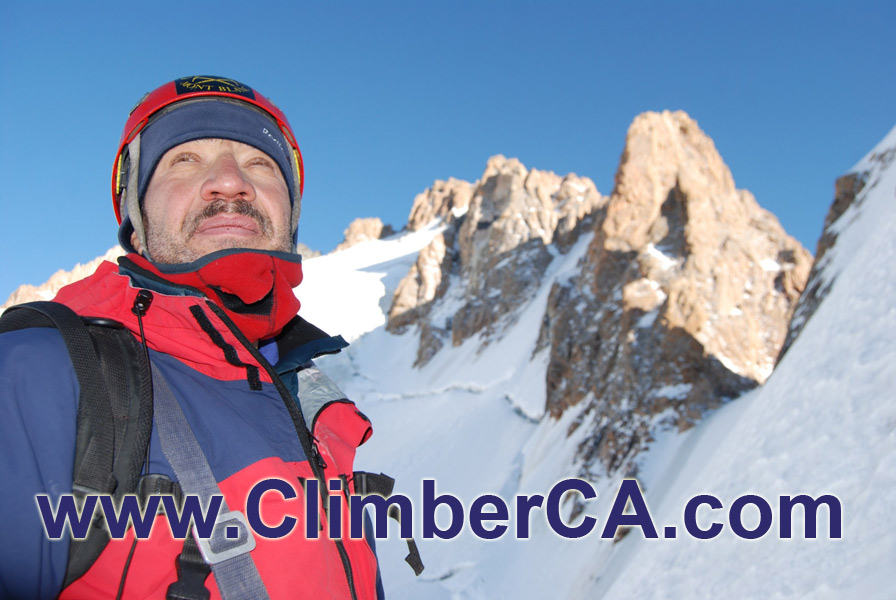
 We recommend your group to be accompanied
by one or more Mountain Guides of
ClimberCA team, working under the direction of Ilyas Tuhvatullin,
who 30.05.2004 reached the summit of
Mt. Everest via a demanding new line up the Central Pillar of Everest's North Face; 22.08.2007 reached the summit of
K2 (Chogori) along the center of the Western face – abrupt rocky bastion etc
... and what is symbolical - made the
first ascent along Khan Tengri North
Face Center, in two-man team, alpine style, for 8 days in 2005. We recommend your group to be accompanied
by one or more Mountain Guides of
ClimberCA team, working under the direction of Ilyas Tuhvatullin,
who 30.05.2004 reached the summit of
Mt. Everest via a demanding new line up the Central Pillar of Everest's North Face; 22.08.2007 reached the summit of
K2 (Chogori) along the center of the Western face – abrupt rocky bastion etc
... and what is symbolical - made the
first ascent along Khan Tengri North
Face Center, in two-man team, alpine style, for 8 days in 2005.
For further information and booking please e-mail us
your@climberca.com or
pagetour@ya.ru
Porter & guide services, rent of
tents for high camps are available for the additional payment:
Guide services:
1 person – 1200 Euro
2 person – 750 Euro per person
3 person – 600 Euro per person
Mountain Safety
As ascending Mountain peaks imply a sojourn in high mountains, everyone must follow specific safety rules. An accident while mountain climbing generally has unexpected and negative consequences. A seemingly small mistake, such as twisting an ankle in loose rocks, can quickly turn into a dangerous situation if the climber is on difficult terrain and is still some distance from the base camp. Climbers can minimize the consequences of these mistakes by traveling in groups, carrying first aid equipment, and being cautious in their route planning. Alpine climbers are also exposed to perils beyond their control, such as hidden crevasses and avalanches, and because of the inhospitable environment of most mountains, they risk exposing themselves to hypothermia and altitude sickness. Experienced mountaineers plan ahead for all contingencies and let others know their destination and planned return time.
Crevasses are deep ice fissures or large cracks within a glacier. Many times crevasses are hidden under a covering of snow, making them difficult to identify. Their steep, slippery sides make them almost impossible to climb out of without assistance. For this reason, climbers often rope together and secure themselves to each other when traveling on glaciers and snowfields. Should one partner fall in a crevasse, the other can break the fall and then pull their partner out.
Avalanches are sudden flows of a large mass of snow or ice down a slope or cliff, sometimes at speeds exceeding 160 km/h (100 mph). They occur when heavy snowfall accumulates on steep slopes and the underlying snow pack cannot support the new snow’s weight. Mountaineers can minimize avalanche dangers by staying aware of rapid changes of weather, especially increases in temperature and wind. They should also avoid steep, narrow chutes that provide ideal channels for avalanches.
Hypothermia occurs when the body becomes too chilled to generate enough warmth for vital organs such as the heart and lungs. Most climbers understand that hypothermia is a danger during extremely cold weather, but it also can occur when temperatures are well above freezing. In fact, most cases occur when the outside temperature is from 7° to 10°C (45° to 50°F). Avoiding hypothermia requires several simple precautions. Mountain climbers should stay dry and avoid cotton clothing, which dries slowly and sucks away body warmth as it does dry. They should eat, drink water, and rest frequently, helping them maintain energy levels.
Altitude sickness, also known as mountain sickness, is caused by insufficient oxygen at high elevations. It causes dizziness, shortness of breath, and confusion, and it can strike climbers at any elevation above 2,400 m (about 8,000 ft). Mountaineers who ascend to higher altitudes often take a day or two to become accustomed to their new environment. They climb slowly when going above 4,500 m (15,000 ft). If climbers develop symptoms of altitude sickness, they should descend immediately to a lower altitude before the condition worsens. Some climbers use bottled oxygen to combat the effects of the sickness and aid their efforts at higher altitudes.
Sources:
Khan Tengri. (2010, January 7). In Wikipedia, The Free Encyclopedia.
Retrieved 12:53, January 26, 2010, from
http://en.wikipedia.org/w/index.php?title=Khan_Tengri&oldid=336310337
http://encarta.msn.com/encyclopedia_761568485_3/Mountain_Climbing.html
|
 Tel.: +99898
303 98 46
Tel.: +99898
303 98 46 WAP version of this page




 Copyright
© ClimberCA
Copyright
© ClimberCA Skype: dmitriy.page